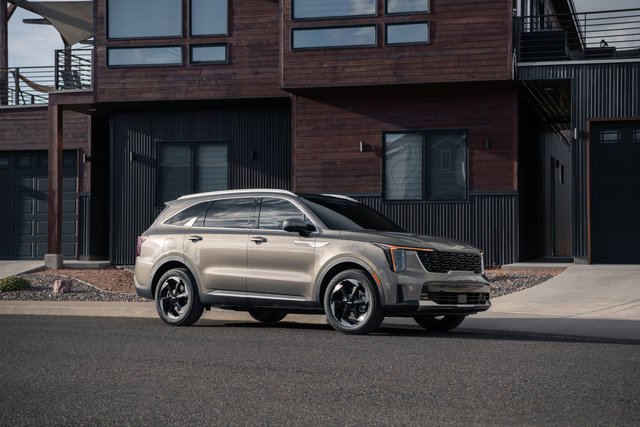
Shopping for a three-row plug-in hybrid means juggling two questions at once: how many people can it carry, and how much stuff can it swallow when the people count drops? For Quebec families cross-shopping the 2027 Sorento PHEV, those two questions are usually tied together.
This guide walks through how the seats fold, what each cargo configuration actually offers, and where the plug-in hybrid layout changes the calculation compared to a standard three-row SUV.
How Does The Seating Layout Work, And How Does Folding Change The Cargo Area?
The 2027 Sorento PHEV keeps the three-row structure across its LX, EX, and SX trims, with six-passenger seating and sliding second-row seats. That sliding second row is the key to flexibility: pushed back, it maximizes second-row legroom for passengers; pushed forward, it opens up more room for third-row cargo before you fold anything.
Folding the second and third rows flat converts the Sorento PHEV from a people-mover into a load-hauler. With both rear rows down, the cargo floor runs from the tailgate to the back of the front seats, turning a compact cargo well into an open load bay for furniture, flat-pack boxes, or building materials.
What’s The Difference Between Cargo Behind The Third Row, Second Row, And Front Seats?
The Sorento PHEV’s cargo space grows in three distinct stages, and each one solves a different problem.
- Behind the third row (all seats up): 357 L, enough for grocery runs, a stroller, or a couple of duffel bags without touching the seats.
- Behind the second row (third row folded, second row slid forward or back): 1,090–1,274 L, depending on second-row slide position, suited to mixed passenger-and-cargo trips like a five-person road trip with luggage.
- Behind the front seats (both rear rows folded): 2,139 L, the full load floor for large or awkward items.
That middle figure matters most for real families: it is not a fixed number but a range tied to where the second row sits, so sliding it forward trades some legroom for extra cargo depth.
What Seat-Folding Conveniences Make This Easier?
The second row features remote folding, so the seatbacks can be dropped from the cargo area or liftgate without walking around to the door. The 50:50 split on the second and third rows means you can fold only the side you need, keeping a passenger seated while the other half carries long items like skis or lumber.
An auto-folding third-row headrest tucks out of the way automatically when that row goes flat, and the Easy Walk In second-row slide clears a path to the third row for anyone still riding back there. Combined, these features are built for repeat, everyday loading rather than a once-a-year cargo project.
Is The Six-Passenger PHEV Layout Different From The Seven-Passenger Hybrid?
Yes. The Sorento’s standard hybrid trims seat seven, while the plug-in hybrid trims are configured for six-passenger seating. The cargo volumes behind each row are the same across both powertrains, so the PHEV does not trade cargo room for its electrified components. What changes is passenger count, not storage capacity.
For a family that regularly carries six or fewer people, that is not a downgrade. For a household that needs a seventh seat for carpooling or extended family trips, it is worth confirming which configuration fits before deciding between the hybrid and the plug-in hybrid.
How Does The Plug-In Hybrid Battery Affect The Cabin And Cargo Setup?
The PHEV runs a larger 13.8 kWh battery and 360 V system, versus the standard hybrid’s 1.49 kWh unit, plus a smaller fuel tank (47 L versus 67 L) to accommodate the added battery hardware. None of this eats into the cargo figures listed above. The PHEV’s fuel economy is rated at 6.9 L/100 km on gasoline alone, with an estimated 55 km of electric-only range from a full charge.
Ground clearance sits at 176 mm, slightly higher than the hybrid’s 174 mm, and the plug-in trims carry a bit more curb weight from the larger battery. None of that changes how the seats fold or how much room you get with them down.
Can It Handle Road Trips, Sports Gear, And Home-Improvement Runs?
With the third row folded and the second row in place, the 1,090–1,274 L range comfortably swallows suitcases, coolers, and hockey bags for a family of four or five heading out for a weekend. Skis, lumber, or a flat-screen box tend to need the full 2,139 L behind the front seats, which means folding both rear rows down.
The standard towing capacity is 748 kg (1,650 lbs (748 kg)), rising to 907 kg (2,000 lbs (907 kg)) when properly equipped, so a small utility trailer or light watercraft trailer is within reach alongside whatever is loaded inside.
What Do You Gain And Lose By Maximizing Cargo Space?
Folding both rear rows delivers the most usable volume, but it also drops seating capacity to two. That trade-off is straightforward for a hardware-store run or an airport pickup with luggage, less so for a mixed trip carrying both people and gear.
The 50:50 split-fold seats are the practical middle ground: fold only what you need, and keep the rest of the row in use for passengers.
Quick Answers: Sorento PHEV Cargo At A Glance
|
Configuration
|
Cargo Volume
|
|
Behind third row (all seats up)
|
357 L
|
|
Behind second row (third row folded)
|
1,090–1,274 L
|
|
Behind front seats (both rear rows folded)
|
2,139 L
|
- Seating capacity: six passengers across PHEV trims
- Second row: slides, splits 50:50, and folds remotely
- Third row: 50:50 split, auto-folding headrest
- Towing: 748 kg (1,650 lbs (748 kg)) standard, 907 kg (2,000 lbs (907 kg)) when properly equipped
Who Actually Benefits From This Cargo Setup?
Households of six or fewer who regularly split trips between passengers and gear get the most from the sliding, split-folding second row: it adapts trip to trip without a full reconfiguration. Anyone doing occasional bulk hauling, like a seasonal furniture move or a load of building supplies, benefits most from the full 2,139 L behind the front seats.
A family that consistently needs a seventh seatbelt should compare the six-passenger PHEV layout against the seven-passenger hybrid trims before committing, since the cargo volumes match but the seating counts do not.
Seeing The Sorento PHEV’s Cargo Setup In Person
The 2027 Sorento PHEV pairs a six-passenger, three-row cabin with a cargo area that scales from 357 L to 2,139 L depending on how the second and third rows are folded. The plug-in hybrid battery adds electric-only range without shrinking that cargo capacity.
Visit Lallier Kia de Laval in Laval to see the seat-folding features in person and test how the second-row slide and remote folding work for your own cargo and passenger mix.
To learn more about the 2026 Kia Sorento PHEV, visit Kia.ca